
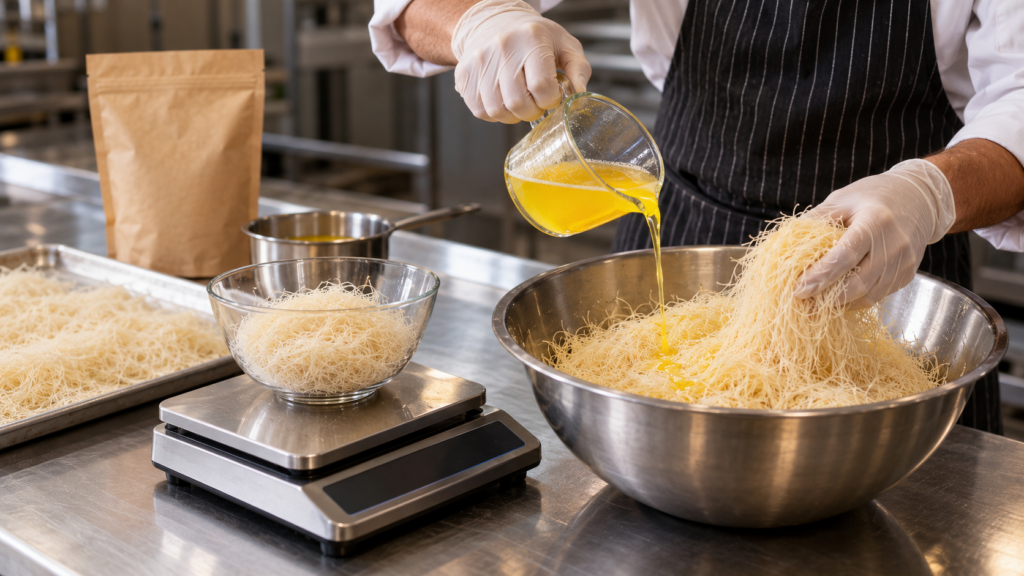
Evenly baked kataifi starts before the tray enters the oven. Restaurants, bakeries, hotels, caterers and cloud kitchens need a repeatable way to weigh, separate and coat the fine strands. If one part of a tray receives too much fat while another part stays dry, the finished colour and crispness can vary. A simple measured process helps the kitchen produce more consistent batches and understand its real ingredient cost.
Why portioning matters
Guessing the amount by hand can change the thickness of every tray. A heavier layer may need more time to colour, while a thin layer can dry quickly. Start with a written recipe for each tray size and record the dough weight before adding butter or another recipe fat. Our guide to kataifi dough quantity per kunafa tray provides a useful planning framework, but every kitchen should test its own tray, filling and oven.
1. Prepare a clean, organised workstation
Place a digital scale, clean tray, mixing bowl and recipe sheet at the workstation before opening the dough. Follow the pack instructions and your kitchen’s food-safety process. The dough should be flexible enough to separate gently; forcing firm strands can increase breakage.
2. Loosen small amounts before weighing
Lift a small amount and separate it with light fingertip movements. Do not compress the strands into a tight ball. A loose texture makes the reading on the scale more representative and helps the butter reach more of the surface. If the dough is still firm, review our guide on thawing kataifi dough without breaking the strands.
3. Tare the bowl and weigh the recipe portion
Place the empty bowl on the scale and use the tare function. Add dough until the required weight is reached. Record the final amount for the tray or batch. When staff use the same weight each time, managers can compare output, waste and cost more accurately.
4. Measure the butter separately
Use the quantity specified by the tested recipe rather than pouring directly from a container. The correct amount depends on the dough weight, tray design, desired finish and production method. Keep all other variables stable during testing so the team can identify what caused a change.
5. Add gradually and distribute gently
Add the measured butter in stages instead of one heavy pour. Lift and turn the strands gently between additions. The aim is a light, reasonably even coating without crushing the dough. Check the bottom of the bowl for a large pool of unabsorbed fat; this may indicate uneven mixing or an unsuitable quantity for the tested batch.
6. Spread to a consistent thickness
Move the coated strands to the tray and distribute them across the full surface. Use a consistent method for edges and corners, because these areas can colour faster. If the recipe uses a base and top layer, weigh both portions separately rather than dividing by eye.
7. Run a controlled bake test
Keep the oven setting, tray, recipe, filling and baking position unchanged for the first comparison. Note the time required to reach the preferred colour. After baking, review colour across the centre and edges, crispness after resting and the amount of usable product. The kataifi dough quality checklist can help structure this test.
Common mistakes
- Weighing a compressed bundle instead of loose strands.
- Adding butter without measuring it.
- Pouring everything into one area of the bowl.
- Mixing aggressively and breaking the strands.
- Changing the tray, oven temperature and recipe at the same time.
- Ignoring the faster colour at tray edges.
A practical production record
For each test, record dough weight, butter quantity, tray size, oven setting, baking time, colour, crispness and finished yield. A short record gives the team a standard to follow during busy shifts and supports better weekly ordering. See our commercial kitchen order-planning guide for the next step.
Frequently asked questions
Should kataifi dough be weighed before or after adding butter?
Weigh the dough before adding butter, then measure the butter separately. This makes the recipe easier to repeat and compare.
Why does one side of a kataifi tray brown faster?
Uneven thickness, uneven coating, tray position and oven hot spots can all affect colour. Test one variable at a time.
How can a commercial kitchen keep portions consistent?
Use a written recipe, digital scale and separate target weights for every tray size or layer.
Where can Mumbai and Thane businesses enquire about supply?
Visit our wholesale kataifi dough supplier page and share the delivery area, expected quantity and order frequency.
Final takeaway
Consistent baking begins with consistent measurement. Loosen the strands gently, weigh the dough and butter separately, distribute the coating in stages and document the result. This routine gives professional kitchens a clearer path to even colour, reliable texture and controlled ingredient use.