
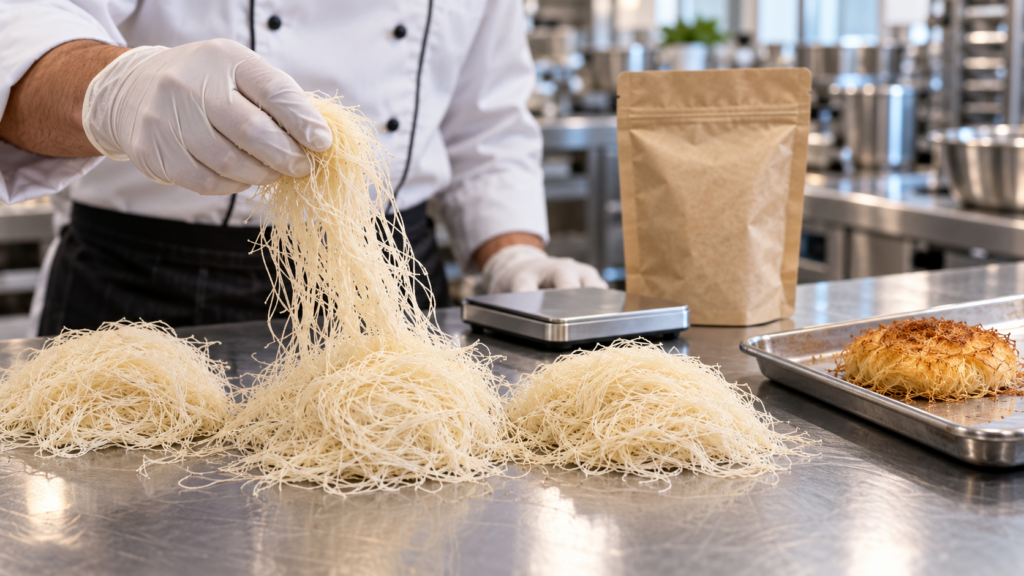
Buying kataifi dough in bulk is different from buying a small pack for one dessert. Restaurants, bakeries, caterers and cloud kitchens need dough that performs consistently across many trays and busy service days. A quick quality check before placing a large order can prevent uneven colour, broken strands, excess waste and last-minute menu problems.
This simple guide explains what to examine when testing a wholesale kataifi dough sample. It is written for professional kitchens in Mumbai, Thane and Navi Mumbai that want a dependable supply for kunafa and other menu items.
1. Check the strands before adding butter
Start with the dough in its original condition. The strands should look fine, separate easily and feel reasonably uniform. A few short strands are normal, but the pack should not contain mostly crushed pieces or one tightly compressed block.
Lift a small handful and loosen it gently. Good kataifi should be workable without aggressive pulling. This matters because excessive handling slows preparation and can create an uneven base or topping.
2. Look for an even natural colour
Raw kataifi dough is normally pale before baking. Look for a generally even shade throughout the sample. Avoid judging quality from one strand alone; examine material from the top, middle and bottom of the pack.
Colour alone does not confirm performance, but obvious dark patches, unusual spots or inconsistent appearance should be discussed with the supplier before a bulk purchase.
3. Test how easily the dough separates
Place a measured portion on a clean tray and separate the strands by hand. The dough should open into a light, workable layer without turning into powder or breaking into very small pieces.
This is an important kataifi dough quality check for high-volume kitchens. Easy separation helps staff portion faster and gives better control over the final thickness of every tray.
4. Run a small controlled bake test
Never approve a commercial order by appearance alone. Prepare two or three small test trays using the same recipe, butter quantity, tray size, oven setting and baking time. Keep these variables fixed so the dough is the only changing factor.
Record the time needed to reach the colour and texture your kitchen wants. The best kataifi dough for restaurants is not simply the one that browns fastest; it is the one that gives a repeatable result under your normal production process.
5. Compare crispness after resting
A tray may feel crisp immediately after baking but soften quickly during holding or delivery. Test the sample at realistic service intervals: soon after baking, after a short counter rest and after the usual delivery window.
Use the filling and syrup level normally used in your kitchen. A fair test should match actual service conditions, not an unusually dry demonstration tray.
6. Measure usable yield and waste
Price per pack is only one part of cost. Weigh the sample before preparation, note the usable quantity and record material lost through crushing, sticking or difficult separation. Then calculate how many standard portions or trays the sample produces.
This makes supplier comparison more practical. A pack with a lower price can become expensive if staff spend extra time sorting it or if the usable yield is poor.
7. Check the pack and cold-chain condition
Inspect the seal, label and condition on arrival. The pack should be intact and should reach the kitchen in the storage condition agreed with the supplier. Ask for clear handling guidance and follow it consistently after delivery.
For safe storage and thawing decisions, use the supplier’s written instructions and your kitchen’s food-safety process. Our kataifi dough storage guide explains the basic planning points in more detail.
8. Ask whether repeat batches will match
A successful sample is useful only if later orders are consistent. Ask the supplier how pack sizes, order frequency and delivery schedules are handled. Professional kitchens should also confirm the best way to report a quality concern with a particular batch.
For a broader supplier review, read our guide to choosing a kataifi dough supplier in Mumbai.
A simple sample scorecard for chefs
Give each area a score from 1 to 5: strand condition, ease of separation, bake consistency, colour, crispness after resting, usable yield, pack condition and supplier response. Test more than one tray before deciding. Keep the completed scorecard with your recipe notes so the same standard can be used when a new batch arrives.
Commercial buyers can also compare expected usage with our weekly kataifi dough order planning guide and check kataifi dough quantity per kunafa tray before selecting a pack size.
Questions to send with a wholesale enquiry
- Which pack sizes are available for commercial kitchens?
- What storage and handling instructions apply?
- Can the kitchen test a sample before a regular bulk schedule?
- How early should repeat orders be placed?
- Which Mumbai, Thane or Navi Mumbai areas can be served?
If your restaurant, bakery, hotel, catering team or cloud kitchen needs a regular dough supply, visit our wholesale kataifi dough supplier page and share your location, expected quantity and order frequency.
Frequently asked questions
How do I check kataifi dough quality before a bulk order?
Inspect the strands, separation, pack condition and appearance, then run a controlled bake test. Compare crispness after resting, usable yield and consistency across more than one tray.
Why should a restaurant request a kataifi dough sample?
A sample allows the kitchen to test the dough with its own recipe, equipment, portion size and service time before committing to a larger or regular order.
What should a wholesale kataifi dough enquiry include?
Include the delivery location, expected pack quantity, order frequency, kitchen type and preferred delivery schedule. Clear information helps the supplier confirm suitability and availability.
Is the cheapest kataifi dough always the best option?
No. Commercial buyers should compare usable yield, staff handling time, bake consistency, waste, pack condition and supply reliability as well as the quoted price.