
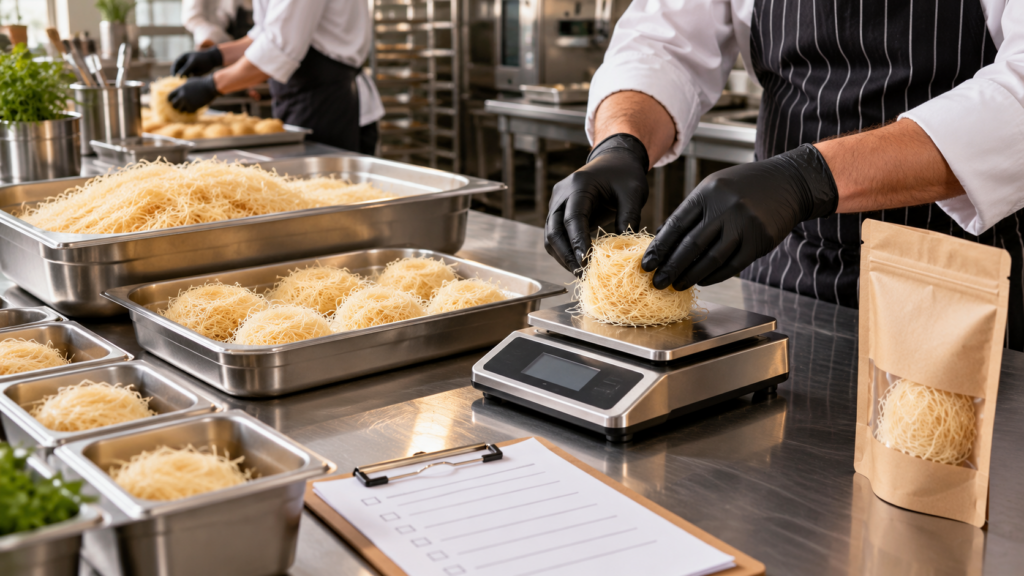
Kataifi dough can become expensive when a kitchen loses usable strands through poor planning, rough handling or inconsistent portioning. Restaurants, bakeries, hotels, caterers and cloud kitchens can reduce waste with a few simple controls. The goal is not to use less than the recipe needs. It is to use the right quantity, protect the dough and measure what happens during production.
Start by measuring the real waste
Before changing the process, track what is being discarded. Separate avoidable waste from normal recipe loss. Record the quantity opened, the quantity used and the quantity that could not be used. Do this for several production days so one unusual shift does not create a misleading result.
A basic worksheet can include the date, pack size, recipe, number of trays, usable quantity, leftover quantity and reason for waste. Common reasons may include broken strands, over-portioning, exposure, incorrect thawing or a change in customer demand.
1. Forecast demand with recent sales
Use recent sales, advance orders, weekday patterns and events to estimate production. A Friday evening may need more dough than a quiet weekday afternoon. A simple weekly forecast helps the kitchen open the right number of packs and avoid preparing too much.
Our weekly kataifi dough order planning guide explains how to combine expected trays, pack sizes and delivery timing.
2. Standardise every tray portion
When different team members use different amounts, costs and results become inconsistent. Create a written recipe with a measured dough quantity for every tray size or menu item. Keep a digital scale at the workstation and make portioning part of the normal process.
Standard portions improve product consistency and make stock planning easier. They also help the kitchen calculate how many trays one pack should produce. See our guide to kataifi dough quantity per kunafa tray for planning ideas.
3. Thaw only what production needs
Opening or thawing more dough than needed can create leftovers that are difficult to manage. Check the production plan before moving packs from storage. Follow the pack instructions and your kitchen’s food-safety procedure.
For a gentle process that protects the fine strands, read how to thaw kataifi dough without breaking the strands.
4. Prepare the workstation before opening
Set out clean trays, a scale, utensils, ingredients and the production sheet before opening the dough. This prevents the pack from sitting exposed while staff search for equipment. A ready workstation also reduces interruptions and helps employees follow the same sequence.
5. Handle the strands gently
Rough pulling can turn long strands into small fragments. Loosen small portions with clean hands and avoid forcing material that is still firm. If the dough is difficult to separate, pause and check the handling instructions instead of pulling harder.
Broken strands are not always unusable, but excessive breakage can make layering slower and less consistent. Regular handling training is therefore a practical cost-control step.
6. Protect the open pack
Do not leave the remaining dough uncovered on the worktable. Protect it according to the supplier’s written instructions and return it promptly to the correct storage condition. Label opened packs clearly so staff know which pack to use first.
Good storage protects both quality and usable yield. Review our kataifi dough storage guide for additional planning points.
7. Use a first-opened, first-used routine
Organise stock so clearly labelled opened packs are identified before sealed packs. The exact rotation method should match the product instructions and the kitchen’s food-safety system. The important point is that staff should not forget a partly used pack at the back of storage.
8. Test new batches before full production
A small controlled test helps the kitchen understand separation, baking performance and usable yield before a busy service. Keep the recipe, tray, butter quantity and oven setting consistent so the dough is the main variable.
Use our kataifi dough quality checklist when comparing a sample or new batch.
9. Record waste at the end of every shift
Ask staff to write a short reason whenever dough is discarded. Do not use the record to blame individuals. Use it to find repeat problems. If most waste comes from over-portioning, improve scale use. If it comes from breakage, review thawing and handling. If it comes from excess production, improve forecasting.
10. Review supplier pack sizes and order frequency
A pack size that is convenient for one kitchen may be too large for another. Compare average production with available pack sizes and delivery frequency. Commercial buyers should also consider usable yield, consistency and handling time, not only the quoted price.
For regular supply enquiries, visit our wholesale kataifi dough supplier page and share your location, expected quantity and order frequency.
Simple weekly waste review
- Total packs opened
- Total dough used
- Total trays or portions produced
- Total leftover or discarded dough
- Main reason for waste
- Action for the following week
Compare the same numbers every week. A small improvement that continues across many production days can create meaningful savings.
Frequently asked questions
What is the easiest way to reduce kataifi dough waste?
Start with measured tray portions and a simple production forecast. These two controls help prevent over-portioning and unnecessary pack opening.
Why does kataifi dough break during preparation?
Breakage can increase when the dough is handled too early, forced apart, allowed to dry or mixed roughly. Follow the pack instructions and loosen small portions gently.
Should kitchens track leftover dough?
Yes. Recording the quantity and reason helps identify whether the main problem is forecasting, portioning, handling, storage or production changes.
How can a business choose a suitable pack size?
Compare expected weekly usage, tray portions, storage capacity and order frequency. Share these details with the supplier before setting a regular order schedule.
Final takeaway
Reducing waste requires a repeatable system: forecast demand, measure portions, thaw carefully, protect open dough and review the numbers every week. These habits support consistent quality while helping a commercial kitchen control ingredient cost.