
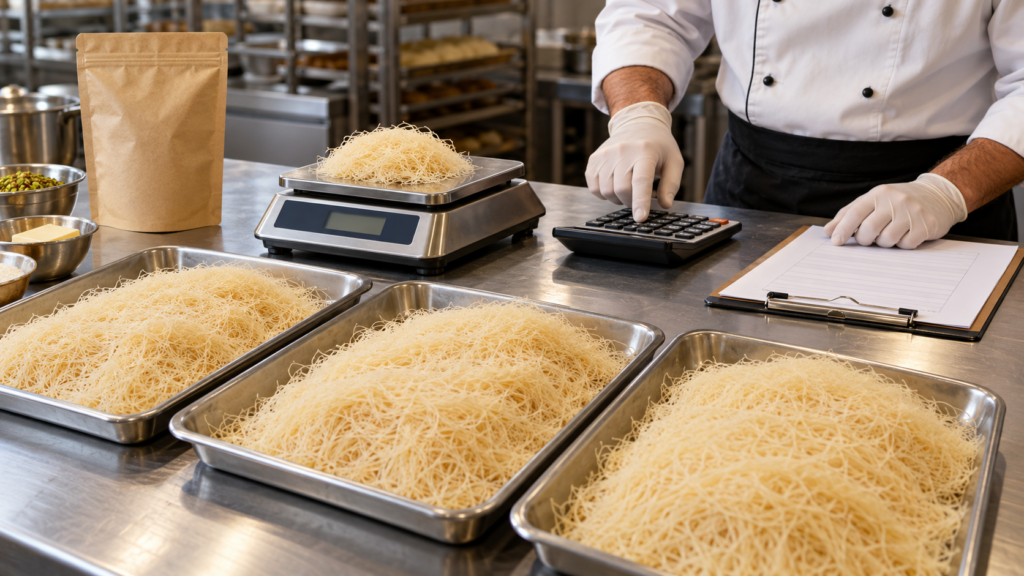
Knowing the price of one pack is not enough for accurate menu costing. A restaurant, bakery, caterer or cloud kitchen needs to know how many consistent trays the usable dough produces. That figure depends on the pack price, usable weight, portion size and avoidable waste. A simple cost-per-tray calculation helps buyers compare batches and plan orders without relying on guesses.
The basic formula
Start with the delivered cost of the pack. Divide the usable dough weight by the standard dough weight used for one tray. This gives the expected number of tray portions. Then divide the pack cost by that number.
Estimated dough cost per tray = delivered pack cost ÷ expected tray portions.
This calculation covers the dough component only. Butter, filling, syrup, labour, packaging, delivery and overhead should be calculated separately.
1. Use the real delivered pack cost
Record the amount actually paid for the dough and any applicable delivery charge assigned to that order. If several products share one delivery, use a consistent allocation method. Do not copy an old quote if the current invoice or order terms are different.
2. Confirm the usable weight
The labelled pack weight is a starting point, but commercial kitchens should also monitor usable yield. Material lost through difficult separation, poor handling or unnecessary exposure affects the real cost. Our guide on reducing kataifi dough waste explains how to track the main causes.
3. Standardise the dough portion
Use a digital scale and record the target weight for each tray size. If the menu offers individual, medium and family trays, calculate them separately. The guide to kataifi dough quantity per tray provides planning considerations, but the final standard must match the kitchen’s tested recipe.
4. Calculate expected tray portions
Divide usable dough weight by the standard portion. For example, if a kitchen has 4,800 grams of usable dough and uses 240 grams per tray, it can plan for 20 dough portions. This is an illustration, not a universal recipe. Your own tested weights should be used.
5. Add a realistic waste allowance
Do not hide recurring waste. If the kitchen normally loses a measurable amount during separation and preparation, include it in usable yield. Then work on reducing the cause. A cost sheet that assumes zero loss may look attractive but will not match actual production.
6. Compare batches using the same method
A lower pack price is not always a lower tray cost. If one batch takes longer to separate or produces less usable material, the effective cost can be higher. Compare pack condition, strand handling, bake consistency and yield using our bulk-order quality checklist.
7. Keep labour and other ingredients separate
Dough cost per tray is one line in the complete recipe cost. Track butter, cheese or cream, syrup, garnish, packaging and labour separately. This makes it easier to see which component changed when total cost rises.
Simple worksheet fields
- Order date and supplier
- Pack size and delivered pack cost
- Usable dough weight
- Standard dough portion per tray
- Expected number of portions
- Actual trays produced
- Leftover or discarded quantity
- Estimated dough cost per tray
Why weekly review helps
Review the sheet with production records at least weekly. If the expected and actual tray counts are different, check portioning, waste and recipe changes. Link this review to the weekly kataifi dough order plan so purchasing follows real usage.
Frequently asked questions
Is pack price the same as dough cost per tray?
No. Cost per tray depends on how many standard, usable portions the pack produces.
Should delivery charges be included?
For internal costing, use a consistent method to include applicable delivered cost. Confirm the method with the person responsible for accounts.
Why should usable yield be measured?
Usable yield shows how much dough actually reaches production after handling and waste.
How can Mumbai businesses request a wholesale quote?
Use the wholesale enquiry page and share location, expected quantity and order frequency.
Final takeaway
A useful cost calculation is based on real delivered cost, measured portions and usable yield. Keep the dough calculation separate from other recipe costs, compare expected output with actual trays and update the figures when purchasing or production changes.