
Running out of kataifi dough during a busy service can stop your dessert line. Ordering too much can create avoidable waste and take up cold-storage space. A simple weekly buying plan helps a restaurant, bakery, caterer or cloud kitchen keep enough dough ready without over-ordering.
This guide explains how to estimate your weekly requirement, choose a practical pack size and build a reorder routine. It is written for commercial kitchens buying wholesale kataifi dough in Mumbai, Thane or Navi Mumbai.
Start with actual kitchen usage
Do not begin with a guess. Use one normal production week and record how much kataifi dough your team opens each day. Keep the numbers simple:
- kilograms opened;
- number of trays or portions prepared;
- unused dough kept for the next day;
- waste caused by drying, breakage or an incorrect batch;
- days when demand was higher than normal.
After seven days, add the total kilograms used. This is your starting weekly demand. Repeat the check for two or three weeks if your sales change sharply between weekdays and weekends.
Use a simple weekly order formula
A useful planning formula is:
Average weekly usage + confirmed extra demand + a small safety buffer = weekly order quantity.
For example, if a kitchen normally uses 8 kg, has a confirmed event that needs another 3 kg, and keeps a 10% safety buffer, the planned order is about 12 kg. The buffer is not meant to cover poor forecasting every week. It is only protection against a small rise in orders or minor preparation loss.
If your team plans production by trays, first measure the dough used in one standard tray. Our guide on how much kataifi dough is needed per kunafa tray can help you build that calculation.
Separate regular demand from event demand
Regular restaurant sales and one-time functions should not be treated as the same order. Keep two lines in your weekly sheet:
- Base demand: the quantity your kitchen normally uses every week.
- Extra demand: weddings, corporate orders, festival menus, catering jobs or promotions already confirmed.
This prevents a large event from making the following week’s order look artificially high. Catering businesses can also use the dedicated kataifi dough for caterers page when planning event volumes.
Choose pack sizes that match your workflow
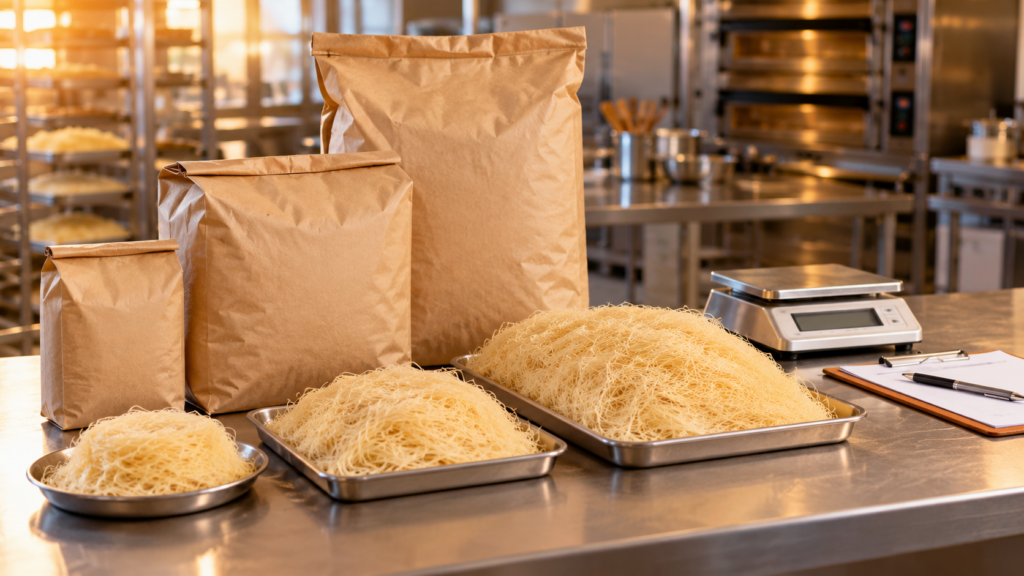
Sufy’s supplies 1 kg, 5 kg and 10 kg packs, with custom quantities available for suitable commercial orders. The right choice depends on how quickly each open pack will move through the kitchen.
- 1 kg packs: useful for trials, low-volume outlets and kitchens adding one new menu item.
- 5 kg packs: practical for regular restaurant, bakery and cloud-kitchen production.
- 10 kg packs: better for high-volume operations, banquet kitchens and planned event production.
Smaller packs can make stock control easier. Larger packs can reduce handling when the kitchen has steady demand. The best option is the pack your team can use efficiently after opening.
Plan around delivery days and storage space
Weekly demand is only one part of the decision. Also check how often the supplier can deliver and how much suitable storage space is available. A kitchen with limited refrigeration may benefit from smaller, more frequent deliveries instead of holding a large quantity.
Keep sealed packs properly stored and label every received batch with its delivery date. Open only the quantity needed for the current production run. For practical handling instructions, read our guide on how to store kataifi dough.
Set a clear reorder point
A reorder point tells the kitchen when to place the next order. A simple method is to calculate how much dough is normally used between ordering and delivery, then add a small buffer.
If the kitchen uses 2 kg per day and the normal lead time is two days, the reorder point should cover at least those two production days, plus a reasonable buffer. The exact number should follow your real sales pattern and agreed delivery schedule.
Assign one person to check stock at the same time every day. This small habit prevents different team members from placing duplicate orders or assuming someone else has already reordered.
Review the plan every week
A weekly plan should improve as better data becomes available. At the end of each week, compare the ordered quantity with actual usage. If stock is regularly left over, reduce the next order. If the kitchen repeatedly comes close to running out, increase the base amount or improve the order timing.
Seasonal demand also matters. Wedding periods, Ramadan, Eid, festive menus and online promotions can change usage quickly. Discuss expected changes early with your supplier instead of waiting until the last production day.
Fresh and frozen dough need different planning
Pack size is not the only buying decision. The form of dough affects handling, storage and preparation time. Before setting a permanent supply routine, compare fresh and frozen kataifi dough for commercial kitchens.
For current rates and available quantities, check the kataifi dough price in Mumbai page. Commercial kitchens can request a supply quote based on outlet type, delivery area and expected weekly volume.
Frequently asked questions
How much kataifi dough should a new restaurant order?
Start with a small trial based on the number of planned portions. Measure actual usage during the first week, then build a regular order from real sales rather than an estimate.
Is it better to place one large monthly order?
Not always. A weekly or scheduled order can be easier to manage when demand and storage space are limited. The best frequency depends on usage, delivery timing and how the dough is stored.
What safety buffer should a commercial kitchen keep?
A small buffer of around 5% to 10% can cover normal variation. Large events and promotions should be added separately because they are confirmed extra demand, not normal variation.
Can different outlets use the same order plan?
Each outlet should record its own usage first. A bakery, restaurant, hotel and cloud kitchen may use the same dough in different quantities and on different production schedules.
Request a weekly supply quote
Share your outlet type, location, preferred pack size and expected weekly quantity with Sufy’s Kanafeh Point. We supply fresh kataifi dough for commercial kitchens across Mumbai, Thane and Navi Mumbai. Call +91 89289 05912 or email Sales@sufyskanafehpoint.in for availability and a quote.
Before approving a repeat bulk order, use our kataifi dough quality checklist to compare strand condition, bake consistency, usable yield and pack condition.